

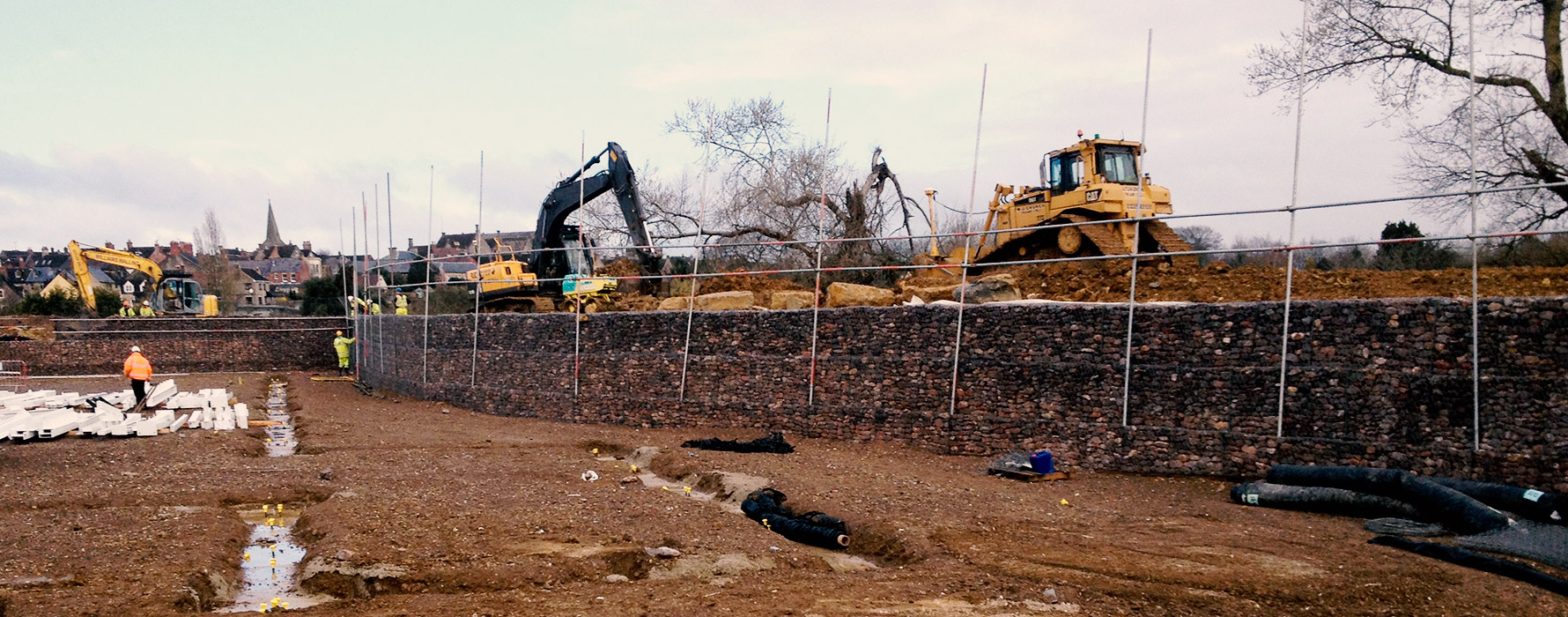
Retaining walls hold back ground where natural slopes will not stand, and SGE installs them as part of integrated earthworks packages across the UK. From reinforced earth walls on infrastructure embankments to gabion walls on residential and commercial developments, we deliver retaining structures alongside the bulk earthworks they support. Building both under one contract removes the awkward interface between the earthworks contractor and a specialist wall contractor, which is where rework and delays usually accumulate.
The right retaining wall solution depends on geometry, loading, ground conditions, visual requirements and budget. A reinforced earth wall might be the right answer on one site and the wrong answer on another. We work from the structural design produced by the consulting engineer and bring practical constructability input to the conversation, particularly on how the wall interacts with the surrounding earthworks, drainage and finished landscape.
Detailed Service Breakdown
Our retaining wall scope covers a range of structure types, selected to suit the application, the geometry and the budget. We work from the structural design produced by the consulting engineer, and we feed back constructability input where it helps. The wall and the earthworks behind it are designed and delivered as a single system.
Retaining wall and earthworks structures we deliver:
- Reinforced earth walls with geogrid or geotextile reinforcement
- Gabion walls for residential, commercial and infrastructure use
- Crib walls and modular block walls
- Mass concrete and reinforced concrete retaining walls
- Soldier pile and lagging walls where space is limited
- Slope reinforcement and shallow retention systems
Industries and Sectors We Work With
Retaining walls are needed wherever level changes can’t be accommodated by natural slope, which puts them across every construction sector. Housing developers use them where plot levels and topography require engineered retention, particularly on sloping sites where maximising developable area is essential. Commercial and logistics developers use them on platforms cut into hillsides or where retaining is needed to achieve the required platform geometry. Infrastructure clients procure significant volumes of reinforced earth walls for highway and rail embankments. Public realm and landscape schemes use gabion and modular block walls for both function and finish. The right wall type depends on the geometry, the loading, the visual requirements and the budget, and we deliver across all of them.
Our Process and Delivery Method
1. Design coordination
We confirm the construction sequence, drainage detail behind the wall, and how the wall ties into the wider earthworks.
2. Foundation and base preparation
Founding ground is prepared to the design level. Where ground improvement is needed, this is delivered as part of the wider package.
3. Wall construction
Walls are built in sequence with backfill placement, with both compacted and inspected as work proceeds. Reinforcement layers, drainage and finishes are installed to drawing.
4. Backfill and earthworks integration
Earthworks behind the wall are placed in coordinated layers, with the right material and compaction for the structure. Drainage behind the wall is critical and is installed as the wall rises.
5. Quality records and handover
As-built records, materials certification and inspection records are kept and handed over as a complete pack.
6. Post-construction support
Retaining structures sometimes require post-construction monitoring or settlement observation, particularly on reinforced earth walls and walls over made ground. We coordinate this where required and remain available for any queries during the asset’s early service life.
Project Examples
Retaining walls have been delivered as part of housing, commercial and infrastructure schemes where level changes required engineered retention. Recent work includes reinforced earth walls on infrastructure embankments and gabion walls on housing schemes where the geometry could not be achieved by slope alone.
Specific examples have included reinforced earth walls forming highway and commercial embankments where land-take constraints made slope retention impractical, gabion walls on residential and rural sites where the visual finish was as important as the engineering, and modular block walls on landscape and public realm schemes. In each case the wall was delivered as part of a wider earthworks scope, with drainage behind the wall installed as the wall rose.
Benefits of Working With SGE
- Wall and supporting earthworks delivered under one contract
- Coordinated drainage behind the wall, installed as the wall rises
- Owned plant for excavation, foundation preparation and backfill
- Multiple wall types delivered, selected to suit the application
- Experienced crews on reinforced earth and modular wall systems
- Single accountability for the structure and the platform it supports
Frequently Asked Questions
Which retaining wall type is most cost-effective?
It depends on height, geometry and ground. Reinforced earth walls are often cost-effective for taller walls; gabion walls suit shorter runs and visible faces. The structural design and the available space determine the best option.
Do you design retaining walls?
No, structural design is produced by the consulting engineer on the project. We deliver to that design and provide constructability input where it helps.
Is drainage important behind a retaining wall?
Critical. Water pressure behind a wall is one of the leading causes of failure. Drainage behind the wall is installed as the wall is built, not added later.
Can retaining walls be combined with earthworks?
Yes, and they should be where possible. Building both under one contract removes the handover risk between earthworks and a separate wall contractor.
How long do retaining walls take to construct?
It depends on wall type, height and length. A modular block or gabion wall a few metres high might be installed in days. A large reinforced earth wall on an infrastructure embankment can run for weeks alongside the rising earthworks. Programme is built around the wider scheme.