

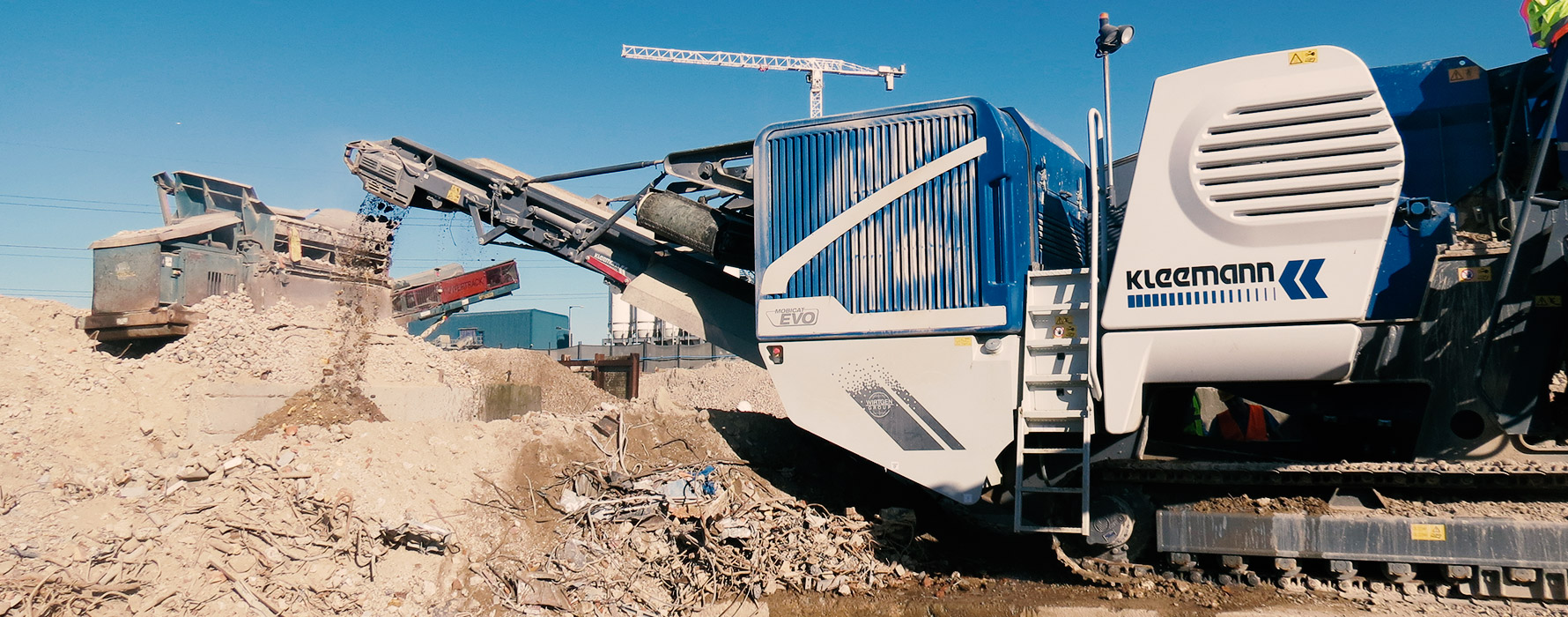
Aggregate recycling turns material that would otherwise leave site as waste into engineered fill, capping and platform product that can be reused on the same scheme. SGE delivers aggregate recycling across the UK on housing, commercial, infrastructure and brownfield projects, either as a standalone service or as part of a wider bulk earthworks and stabilisation package. The case for recycling is increasingly straightforward: it cuts disposal cost, reduces import of primary aggregate, lowers lorry movements and supports the embodied carbon targets now written into most major contracts.
Most large-scale construction projects produce arisings that can be processed and reused. Demolition concrete, masonry, hardcore, broken-out paving and site-won stone are all candidates. The question is rarely whether the material can be reused; it is whether the project programme and laydown space allow on-site processing, and whether the specification for the intended end use can be met. We help answer all three questions and deliver the recycling where it makes sense.
Detailed Service Breakdown
Our aggregate recycling service includes mobile crushing and screening on site, blending to specification, stockpile management and quality testing through UKAS accredited laboratories. We process concrete and masonry arisings, hardcore, demolition material, site-won stone and oversized fill into a graded product that meets the specification for its intended end use, whether that is general fill, capping layer, piling mat or sub-base.
Aggregate recycling applications we deliver:
- Concrete and masonry crushing for use as 6F2, 6F5 or specified fill
- Demolition arisings processed for reuse as engineered fill
- Site-won stone screened and blended for capping or sub-base
- Stockpile and laydown management on multi-phase schemes
- Mobile processing on site to remove transport cost
Industries and Sectors We Work With
Aggregate recycling is a cross-sector service, but the demand is strongest where projects combine demolition arisings with significant fill requirements. Brownfield housing and commercial regeneration is the largest single market. Public sector regeneration projects, particularly those with embodied carbon targets attached to funding, increasingly specify on-site recycling. Highway and infrastructure schemes use recycling on rehabilitation projects where existing pavement and bound material is processed for reuse. Renewable energy developers use recycled aggregate on internal haul roads and substation platforms. The constant across all sectors is that recycling makes sense whenever the volume of arisings is large enough to justify mobile plant on site.
Our Process and Delivery Method
1. Material assessment
We assess the material available and confirm what it can realistically be processed into. Specifications for the intended end use determine the crusher set-up and screening configuration.
2. Set-up of mobile plant
Mobile crushers and screeners are mobilised to a suitable laydown area on site. Dust, noise and traffic management are agreed with the site team before production starts.
3. Processing
Material is processed to the agreed specification. Stockpiles are separated by product so the right material reaches the right part of the site.
4. Testing and quality control
Samples are tested through UKAS accredited laboratories to confirm grading and specification compliance. Records are retained for the project quality pack.
5. Reuse on site
Processed product is placed and compacted as part of the wider earthworks. Where SGE is delivering both, this is a seamless single workflow with no offsite transport, no double-handling and no contractual interface between the recycling and the earthworks.
Project Examples
Aggregate recycling has been used on housing schemes, commercial platforms and brownfield regeneration sites where demolition arisings and site-won material were processed for reuse as engineered fill, capping and piling mat. Recent schemes have reduced imported aggregate by tens of thousands of tonnes, with proportional reductions in lorry movements and embodied carbon.
On regeneration sites where demolition has produced large volumes of concrete and masonry, processing on site has replaced what would otherwise have been thousands of skip and tipper movements through residential streets. On rural commercial sites, screening of site-won stone has produced graded capping and sub-base product to highway specification, removing the need to import aggregate over long distances. The principle is the same in each case: process what is already on site, use it for the application it suits, and remove the cost and carbon of transporting material in and out unnecessarily.
Benefits of Working With SGE
- Mobile plant brought to site, no offsite transport for processing
- Single contractor for crushing, screening and reuse in earthworks
- Lower lorry movements and reduced public road impact
- Embodied carbon reductions to support contract sustainability targets
- Lower disposal cost compared with offsite removal
- Experienced crews trained on mobile crushing and screening plant
Frequently Asked Questions
What materials can be recycled into aggregate?
Concrete, masonry, hardcore, demolition arisings and site-won stone are the main feedstocks. The end product depends on the specification required.
Is recycled aggregate as good as primary aggregate?
For most fill, capping and sub-base applications, properly processed recycled aggregate meets specification and performs equivalently. Specifications and end use determine the right product.
Can crushing and screening happen on a live construction site?
Yes, with appropriate management of dust, noise and traffic. Mobile plant is configured to suit the site, and we plan operations around the wider construction programme.
Does aggregate recycling reduce project carbon?
Significantly. Reusing site-won material avoids the embodied carbon of primary aggregate production and the transport carbon of importing and exporting material.